The end of the run is dim
Likely cause: Voltage drop under load
Add power before the point where brightness begins to fall.

Installation Guide
Power injection keeps permanent LED lights bright and color-accurate across long roofline runs. This guide covers when it's needed, why voltage drop happens, and how to wire it cleanly.

The electrical principle
Power injection feeds fresh low-voltage power into a permanent LED run after the first section has consumed some of the available voltage. Each puck uses a small amount of power; as the run grows longer, the lights farthest from the controller receive less voltage.
Voltage drop is easiest to see on bright white and high-output colors. A run can look fine on dim accent effects and still shift color, flicker, or lose brightness when used at full output.
Troubleshooting
Distance alone does not decide it. Voltage, brightness, wire gauge, connections, and the number of lights all affect the result. Test the completed run on bright white before final mounting.
Likely cause: Voltage drop under load
Add power before the point where brightness begins to fall.
Likely cause: Insufficient voltage at high output
Verify voltage under load, then inject power using the correct cable gauge.
Likely cause: Weak power, a poor splice, or excessive run length
Check every connection and shorten the powered section or add an injection point.
Likely cause: A data-path or segment issue
Check data direction, the controller output, and segment settings before adding power.

A permanent lighting controller may use several data outputs and several power injection outputs. Use separate data outputs for cleaner segments, then inject power where longer runs need fresh voltage -- this prevents one roofline run from being forced to carry all of the power from the controller to the last light.
Power injection and data wiring solve different problems. Power injection sends new positive and negative power to the lights. Data wiring tells each LED what color and effect to display. If the lights are dim or color-shifted, check power first. If the lights are bright but the pattern is wrong, check the data path or segment settings.

Every wire, connector, and LED adds resistance. The longer the cable and the more LEDs in the run, the more resistance the system has to overcome. Lower-quality cable, thin wire, long home runs, and poor connections make the problem worse.
For permanent roofline lights, voltage drop isn't only a brightness issue -- it can also affect color accuracy. Red, green, blue, and white don't all show symptoms the same way, so a run can look fine in one preset and fail in another.
A properly injected run keeps brightness consistent across the roofline. Without enough power, lights can appear dim or uneven—especially at the far end of a long run.


Use cable with enough conductors and the correct gauge for the distance, load, and installation plan. For longer distances, 16 AWG cable is often a better choice than thinner wire because it reduces resistance and helps deliver more stable voltage. Cable quality, splice quality, and weather protection matter as much as the wiring diagram.
For installation planning, also see the installation tools and wiring recommendations, the installation guide, and the LED count and segment setup guide.


Before energizing the run
Power injection is project-specific. Match the controller voltage, maintain polarity, and protect every outdoor connection before applying power.
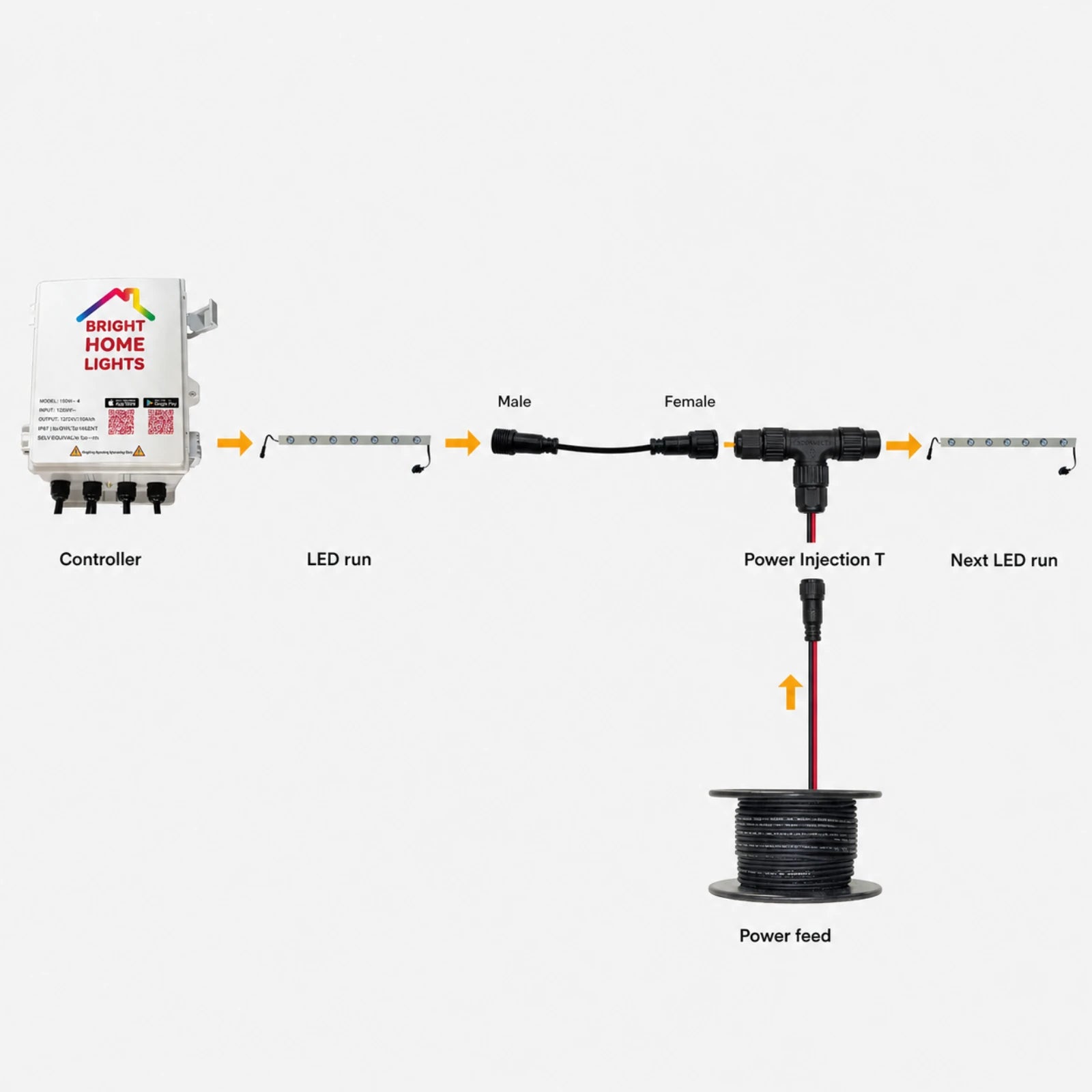
Connection
Fresh positive and negative power can enter farther down the run while data continues through the light string.
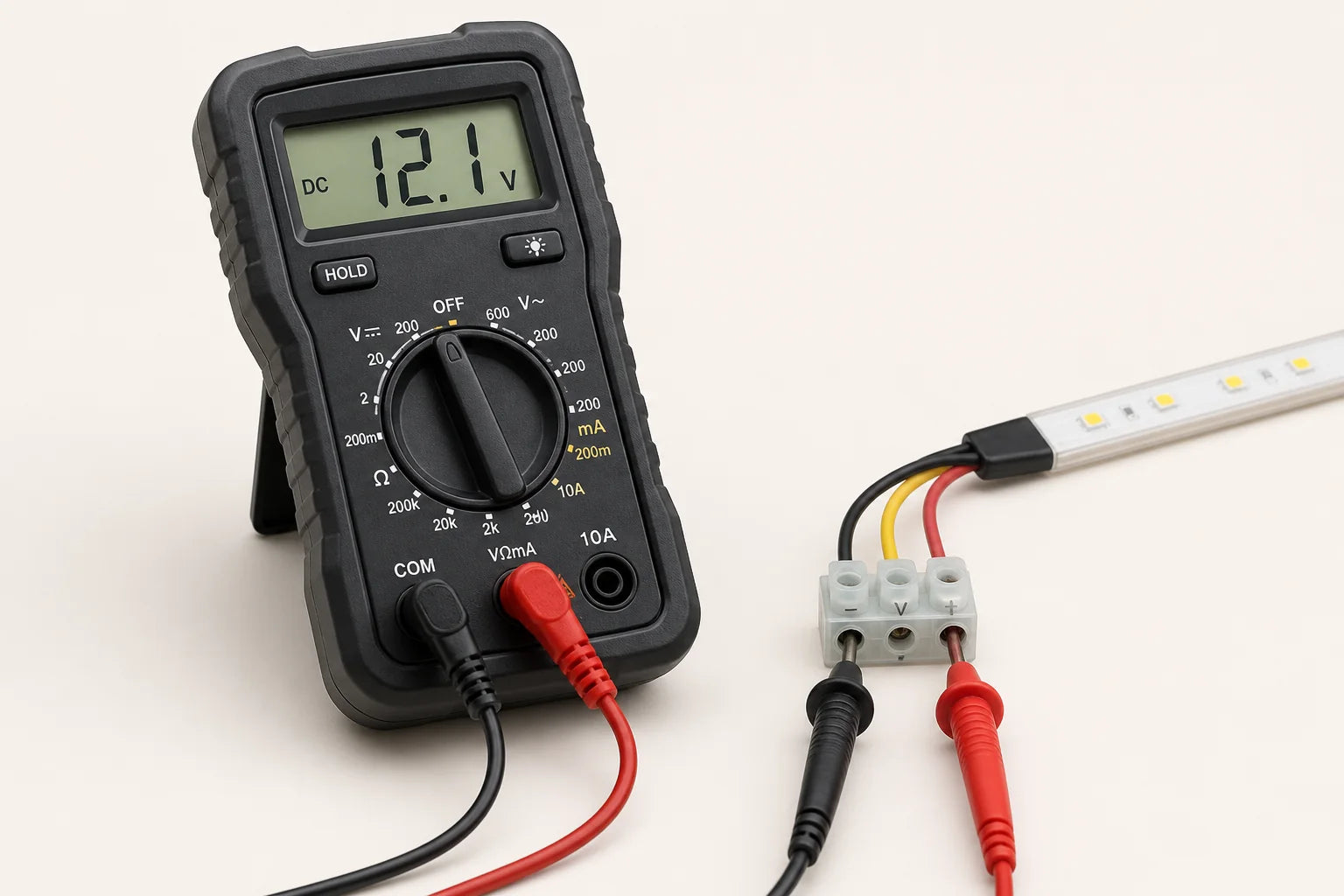
Electrical check
Verify the correct system voltage and polarity, then test bright white at the far end of the run.
Weather protection
Keep non-waterproof lever connectors and splices inside a suitable dry, protected enclosure.
Installer note
Don't guess based only on the number of lights. Test bright white and high-output effects after wiring. If the end of the line drops brightness or shifts color, add injection before calling the run complete.
You likely need power injection if the end of a permanent LED light run is dim, flickers, or shows the wrong color when bright effects are used.
Yes. Power injection adds fresh positive and negative power. Data can continue from the previous light when the data signal is still reliable.
No. Power injection fixes voltage drop and weak power delivery. If lights are bright but the effect is wrong, check the data direction, controller output, and segment settings.
Wire gauge depends on distance and load, but 16 AWG cable is commonly used for longer low-voltage permanent lighting runs because it reduces resistance compared with thinner cable.
Yes. Planning injection points before mounting the lights keeps the install cleaner and reduces the need for extra home runs after testing.