
BHL + GOOGLE GEMINI
Connect BHL WLED Lights to Gemini
Use Gemini to control compatible WLED and permanent lights connected to your Bright Home Lights cloud account. Follow the setup steps, enable AI access, and try a lighting request.
Before you start
Have your BHL account ready
Use the BHL account that contains your lights. You will add Bright Home Lights as a custom app in Gemini, then sign in to BHL to finish connecting.
MCP is the connection that lets an AI assistant work with the BHL devices and presets you allow.
https://mcp.brighthomelights.com/mcpPrepare your BHL devices
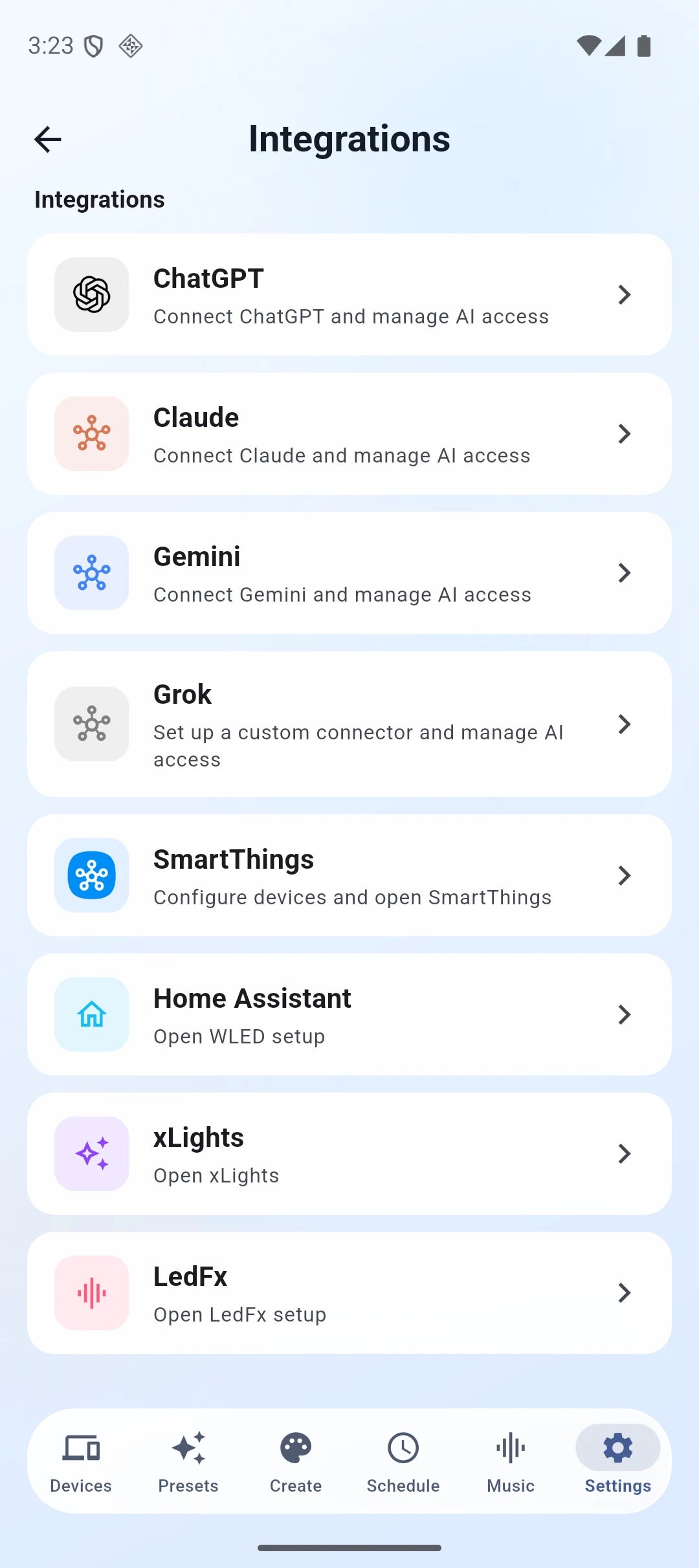
In the BHL app, open Settings → Integrations → Gemini. The iPhone screenshot shows an earlier app version.
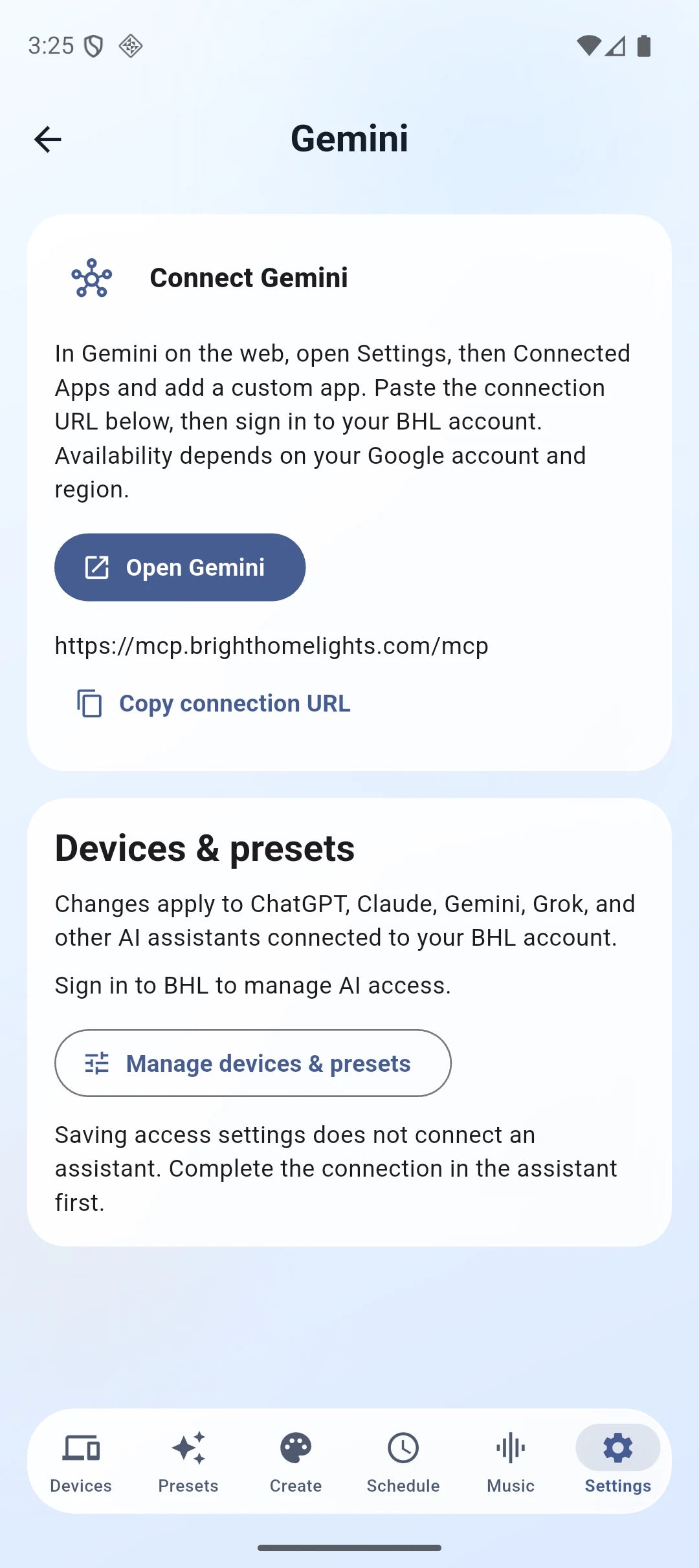
Select Manage devices & presets to review which devices are enabled for AI access. Save any changes, then return to the Gemini screen and select Copy connection URL.
The BHL screen states that changes apply to ChatGPT, Claude, Gemini, and other assistants connected to your BHL account. Saving these settings does not complete the connection in Gemini.
The device count shown is an example. Your account will show your own devices.
Open Connected Apps in Gemini
Open Gemini on the web. Go to Settings → Connected Apps. If your menu shows Personal Intelligence first, open it to find Connected Apps.
Choose Custom apps. In the supplied Spark interface, Connected Apps is also visible in the left sidebar.
Add the Bright Home Lights MCP URL
Select Add a custom app, or use the custom-app URL field if Gemini shows one. Paste the BHL connection URL into MCP Server URL, then select Next.
https://mcp.brighthomelights.com/mcp
Check that the field matches the screenshot, including https:// and the final /mcp.
Review the custom app and select Connect
When Gemini shows Save your custom app, check that the name is Bright Home Lights. Review the available actions, then select Connect.
The screenshot includes device status, devices, and presets. The action count and sync time may change as BHL updates the integration.
Link your accounts and sign in to BHL
Follow the account-linking prompts from Google and BHL. Review the Google account-linking screen for [Custom] Brighthomelights and continue through the on-screen prompts. The order of these screens can vary with your existing sign-in state.
Use your existing BHL account
On the BHL sign-in screen, enter the email and password for the BHL account that holds your lights. Review the permissions, then select Sign in and connect to Gemini.
The displayed permissions cover viewing devices and presets, controlling lights, creating presets, and managing schedules and sports automations. Check the permissions shown during your own connection.
Return to Gemini when the flow finishes. For help, see account sign-in troubleshooting.
Confirm BHL is connected
Find the Bright Home Lights card under custom apps and check that its switch is on. The screenshot shows the connected state; your sync date will differ.
In Gemini chat or a Spark workflow on web or mobile, type @ and select Bright Home Lights. Then ask:
“Which Bright Home Lights devices can you access?”
Check the response against the devices you enabled in BHL before asking for a lighting change.
Find the connection in the BHL app
Open Settings → Integrations → Gemini. These Android app screens show the signed-out view; sign in to BHL to manage device and preset access.
What you can ask BHL to do
MCP connects your assistant to the BHL account, devices and presets you allow. Start with a device check, name the device in later requests, and review the proposed action before confirming a change—especially a permanent deletion.
Actions depend on account and device access, permissions and connectivity. These examples describe supported connector capabilities; they are not a claim that every command has been independently tested on every assistant. The assistant may ask you to clarify the device, preset or schedule.
Check your connection and lights
Check account connection
Check your BHL account connection and granted permissions.
Example: Is my Bright Home Lights account connected?
List your devices
List accessible cloud-provisioned devices, including online, offline or unknown status. Status is cached and may be delayed; an offline result does not explain the cause.
Example: List my lights and their online status.
Read current controller state
Request fresh power, brightness, active preset, effect and color information for a device.
Example: Check the current state of Patio Lights.
Browse saved presets
List saved presets visible to your account on a chosen device.
Example: Show my Studio presets.
Set lights and manage presets
Change your lights
Turn a device on or off; set brightness from 0–100%, one RGB color, a supported effect, or effect speed/intensity from 0–100%. Friendly styles include solid, breathe, blink, colorloop, chase, twinkle, rainbow and fireworks. Optional durations are 1–1,440 minutes with previous-state restore. Each device operation targets one device; changes to multiple devices are applied separately.
Example: Set Patio Lights blue at 40% for 10 minutes, then restore the previous lights.
Run a saved preset
Apply an existing preset to a chosen device, optionally for 1–1,440 minutes and then restore the previous state.
Example: Run Evening on Patio Lights for 30 minutes, then restore the previous lights.
Create a new preset
Create a new, non-overwriting preset with a 1–32 character name, one to three RGB colors, a supported style, brightness and supported effect settings. Saving briefly changes the lights to verify the result and normally restores the prior state. Confirm whether to leave the preview active. Arbitrary effects and pixel-by-pixel editing are not supported.
Example: Create a blue-and-gold twinkle preset called Game Night on Patio Lights; restore the previous lights afterward.
Delete a preset
Permanently delete an owner-controlled preset after confirming its exact name and device. A preset used by a schedule or sports automation cannot be deleted until that dependency is resolved.
Example: Help me delete Game Night from Patio Lights; confirm the exact preset before deleting.
Review and recover changes
Review recent activity
See recent AI lighting actions.
Example: Show my recent AI lighting activity.
Undo the latest AI change
Undo the latest still-active AI lighting change across your account, without overwriting newer unrelated changes.
Example: Undo my last AI lighting change.
Restore a device’s previous state
Restore a captured prior state for a chosen device and applicable action. This cannot recover an arbitrary historical moment.
Example: Restore the captured previous state of Patio Lights.
Cancel an automatic restore
Cancel a pending timed restore, normally leaving the current lighting unchanged. Request an immediate restore explicitly if desired.
Example: Cancel the pending restore on Patio Lights and keep the current lights.
Schedules and sports automations
View automations
List device schedules and sports automations, including whether each is enabled.
Example: Show my Patio Lights schedules and sports automations.
Find supported sports options
Discover currently supported sports, competitions, teams and event triggers before choosing a celebration.
Example: Which teams and sports events can trigger my lights?
Create a schedule or sports automation
Create recurring fixed-time schedules on selected weekdays using device-local time and an existing preset. Sports automations use supported team/event options and an existing preset, with auto-run or ask-first mode, a 1–60 minute duration and optional cooldown. Creating sunrise/sunset schedules is not supported, even if existing schedules show those types.
Example: Run Evening on Patio Lights at 7 PM every day. Confirm the device-local time before saving.
Edit an automation
Edit supported name, enabled state, preset, fixed time, weekdays, mode or duration fields. Changing a sports team or trigger requires deleting and recreating that automation.
Example: Change my Evening schedule to 8 PM on weekdays.
Pause or enable an automation
Enable or disable a schedule or sports automation without deleting it.
Example: Pause my Evening schedule.
Delete an automation
Permanently delete the exact confirmed schedule or sports automation.
Example: Help me delete the Evening schedule; confirm which one before deleting.
Test an automation
Apply the automation’s preset for one minute, then restore the prior lighting. This does not simulate a real sports event.
Example: Test my Patio Lights celebration for one minute, then restore the previous lights.
Need a hand?
Connected, but something is missing?
Check the account, device permissions, and custom-app connection.
Permanent lighting and WLED compatibility
Control compatible WLED lights connected to your Bright Home Lights cloud account using natural language. Devices must be connected to your BHL cloud account and enabled for AI access. A standalone local WLED controller is not automatically accessible through the BHL MCP connector; support depends on the device and firmware. This connection does not provide arbitrary raw WLED commands.
For permanent Christmas lights, roofline lighting or everyday outdoor lighting, begin by checking which devices the assistant can access. Name the device in your request, then ask for a supported color, brightness or saved preset. Each device operation targets one device; changes to multiple devices are applied separately.
Need to prepare your controller? See controller Wi-Fi setup, WLED LED count and segments, and the Bright Home Lights app guide.